Artemis II Live Tracker
The ultimate Artemis 2 tracker - follow four astronauts as they journey around the Moon aboard the Orion spacecraft, farther from Earth than any human has traveled in over half a century.
Welcome to the Artemis II tracker - your real-time dashboard for NASA's historic crewed lunar flyby mission. This Artemis 2 tracker features a live countdown, crew profiles, mission timeline, and live stream links. Whether you know it as the Artemis tracker or the Artemis 2 live tracker, you'll find everything you need to follow four astronauts as they journey around the Moon and back to Earth.
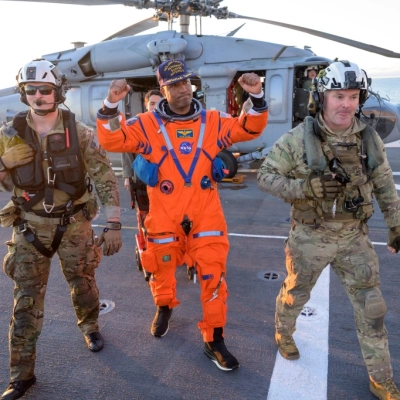
Artemis II Mission Gallery
Latest images from the Artemis II mission
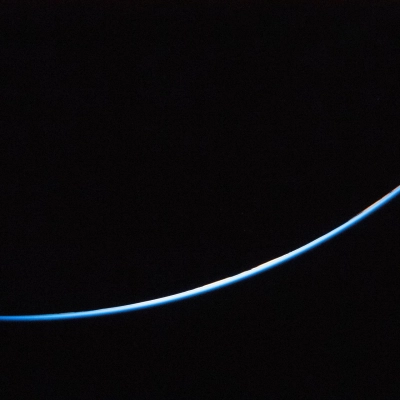

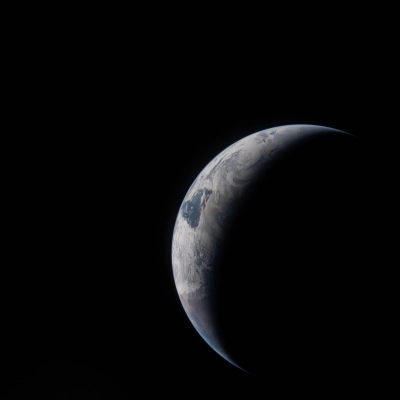
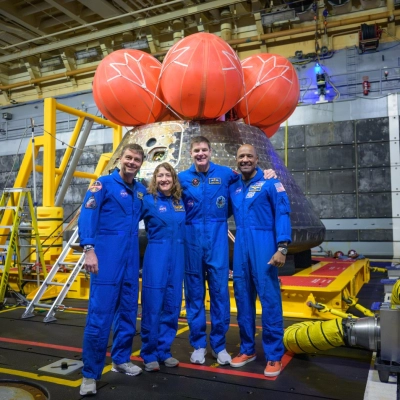
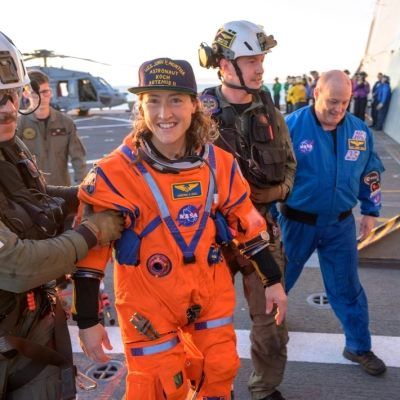
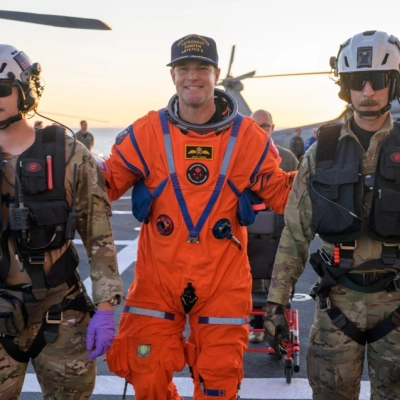
![3]NASA’s Orion spacecraft is seen as the agency’s Landing and Recovery team, along with U.S. Navy personnel work to recover...](https://www.jameswebbtracker.com/storage/thumbnails/e8542fd68fdb150872e4abd2ef852b90_thumb.webp)
Mission at a Glance
Meet the Crew
Four astronauts will make history aboard Orion - the most diverse crew ever sent beyond low Earth orbit.
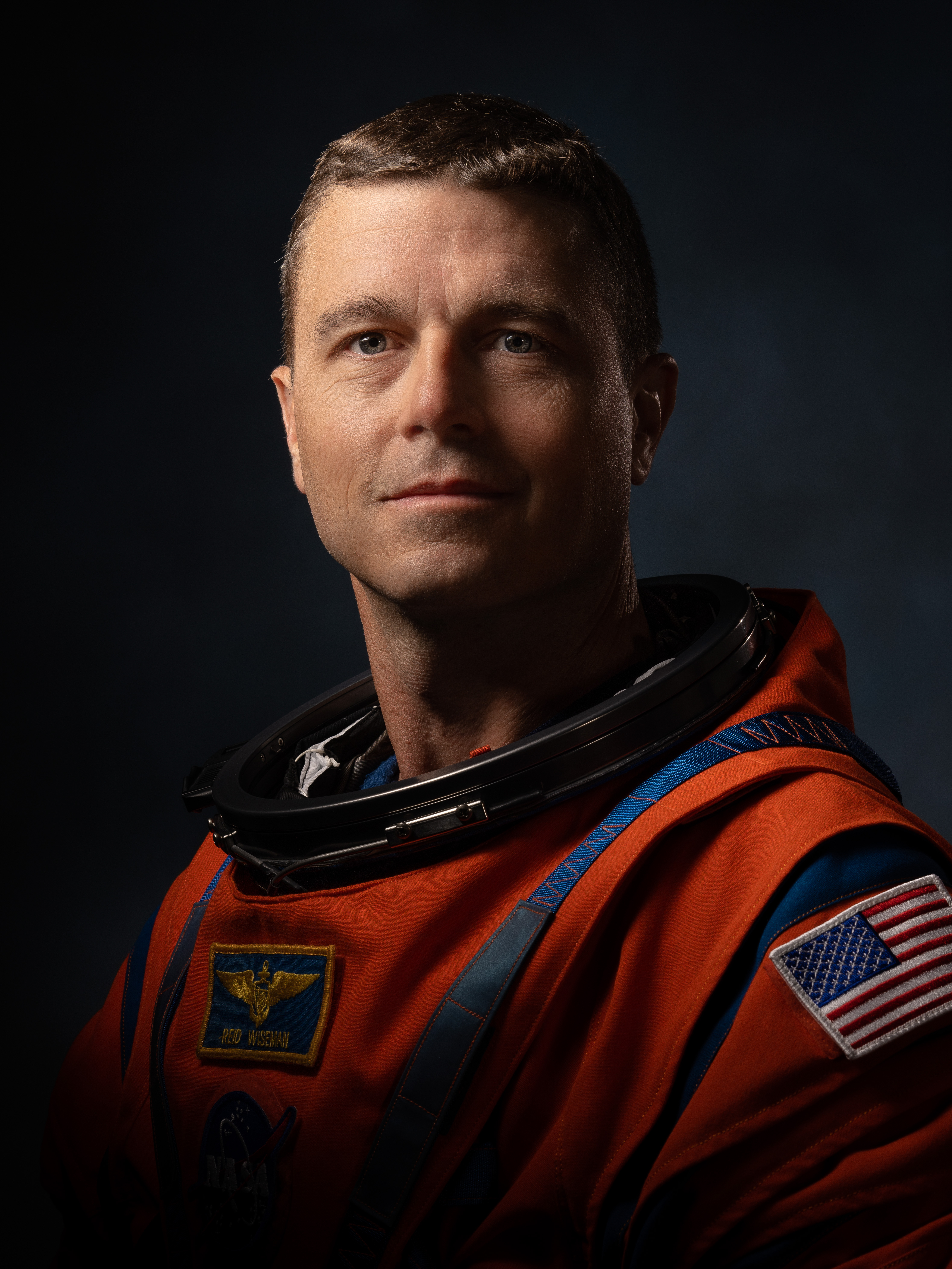
Reid Wiseman
🇺🇸 United States
Navy test pilot and veteran astronaut. Spent 165 days aboard the ISS on Expedition 41. Selected by NASA in 2009.
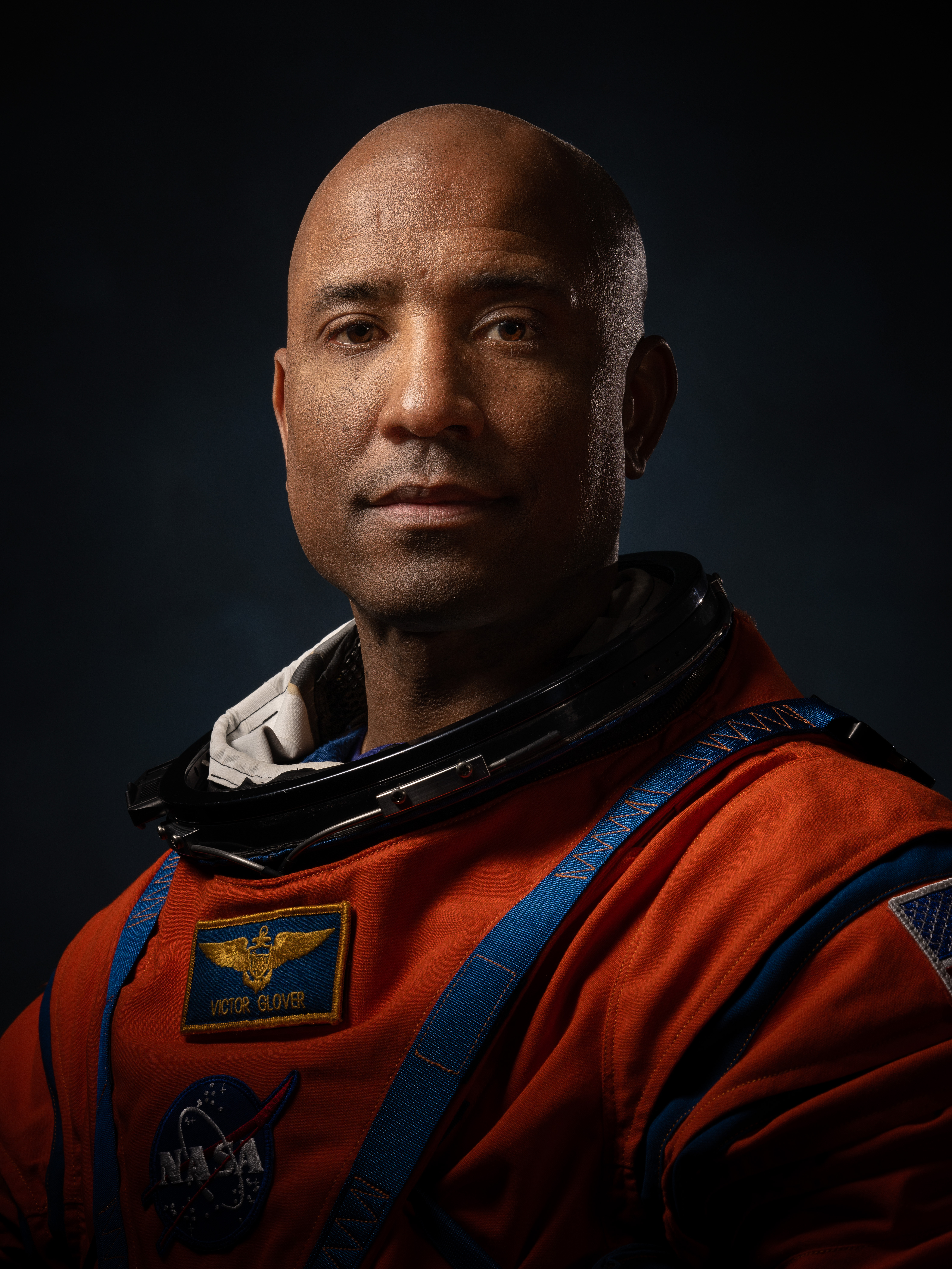
Victor Glover
🇺🇸 United States
Navy test pilot and NASA astronaut. Served as pilot on SpaceX Crew-1, the first operational Crew Dragon mission to the ISS.
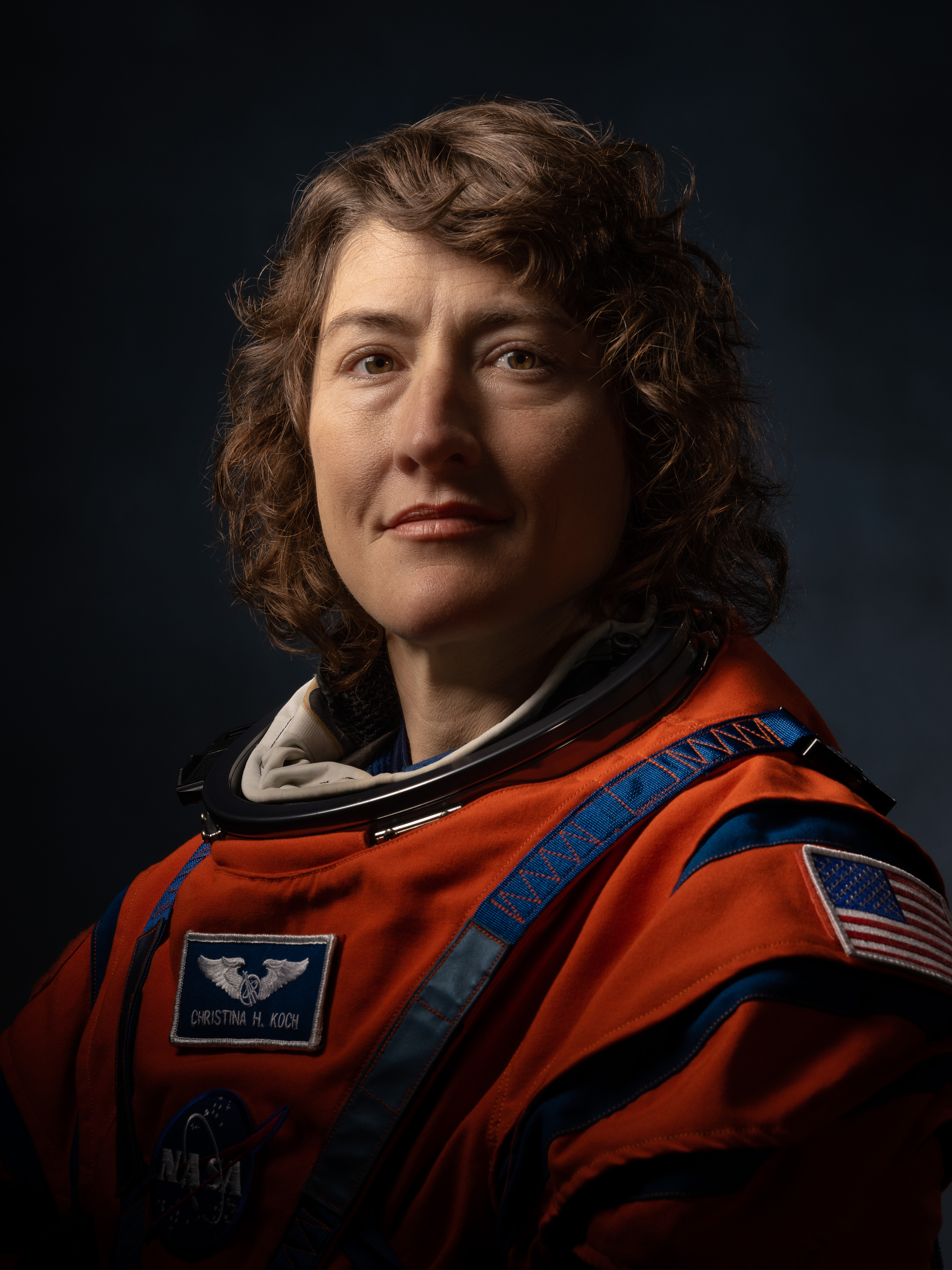
Christina Koch
🇺🇸 United States
Holds the record for the longest single spaceflight by a woman (328 days). Participated in the first all-female spacewalk.

Jeremy Hansen
🇨🇦 Canada
Canadian Space Agency astronaut and former CF-18 fighter pilot. Selected in 2009, he will be the first Canadian to fly beyond low Earth orbit.
Mission Timeline
Key milestones of the Artemis II lunar flyby mission.
Launch
SLS lifts off from Kennedy Space Center Launch Pad 39B, sending Orion and the crew toward the Moon.
Translunar Injection
The Interim Cryogenic Propulsion Stage (ICPS) fires to send Orion on a trajectory toward the Moon.
Outbound Coast
Orion cruises toward the Moon. The crew tests spacecraft systems and conducts science experiments including AVATAR.
Lunar Flyby
Orion performs a powered flyby of the Moon, passing approximately 6,400 miles above the lunar surface.
Return Coast
After swinging around the far side of the Moon, Orion begins its journey back to Earth.
Re-entry & Splashdown
Orion re-enters Earth's atmosphere at approximately 25,000 mph and splashes down in the Pacific Ocean.
Historic Firsts
Artemis II will set multiple records and milestones in human spaceflight.
First Woman Toward the Moon
Christina Koch will be the first woman to fly on a lunar mission.
First Black Astronaut Toward the Moon
Victor Glover will be the first Black astronaut to travel beyond low Earth orbit.
First Canadian Beyond LEO
Jeremy Hansen will be the first Canadian to fly beyond low Earth orbit.
First Crewed Artemis Flight
The first crewed mission of NASA's Artemis program, following the uncrewed Artemis I in 2022.
Farthest Humans from Earth in 50+ Years
The crew will travel farther from Earth than any human since Apollo 17 in 1972.
About the Moon
Our closest celestial neighbor and the destination for Artemis.
Distance from Earth
The Moon orbits at an average distance of 238,855 miles (384,400 km) from Earth.
Water on the Moon
Scientists have confirmed water ice exists in permanently shadowed polar craters, and water molecules on sunlit regions.
Ancient Surface
The lunar surface is heavily cratered, preserving billions of years of solar system impact history with no wind or weather to erode them.
Internal Structure
Like Earth, the Moon has a layered structure: a solid core, a mostly solid mantle, and a thin outer crust.
AVATAR Science Experiment
Studying human biology beyond Earth
The AVATAR (A Virtual Astronaut Tissue Analog Response) investigation will use organ-on-chip devices to study the effects of radiation and microgravity on human tissue during deep space travel. This cutting-edge research will help scientists understand how the human body responds to the harsh environment beyond Earth's protective magnetosphere.
Frequently Asked Questions
Everything you need to know about NASA's Artemis II crewed lunar flyby mission.
results found
Artemis II is NASA's first crewed mission to the Moon in over 50 years. Four astronauts will fly aboard the Orion spacecraft on a roughly 10-day journey around the Moon and back to Earth. It is the second flight of the Space Launch System (SLS) rocket and the first to carry a human crew, serving as a critical test before future lunar-landing missions.
Artemis II launched on April 1, 2026, at 6:24 PM EDT from Launch Pad 39B at Kennedy Space Center in Cape Canaveral, Florida. The launch window was determined by the Moon's orbital position to ensure the optimal trajectory for a free-return lunar flyby.
The Artemis II mission lasts approximately 10 days from launch to splashdown. This includes about 4 days traveling to the Moon, a powered flyby of the lunar surface, and roughly 5 days returning to Earth before splashing down in the Pacific Ocean.
The primary goal is to test the Orion spacecraft's life-support systems, navigation, and communication capabilities with a human crew on board during a deep-space mission. It validates that all systems work safely before NASA sends astronauts to the lunar surface on Artemis III. Secondary objectives include conducting science experiments like AVATAR and demonstrating the SLS rocket's performance with a crewed payload.
No. Artemis II is a lunar flyby mission, not a landing mission. The Orion spacecraft will fly approximately 6,400 miles above the Moon's surface, swing around the far side, and return to Earth. The first crewed lunar landing since Apollo 17 is planned for the Artemis III mission.
Artemis I (launched November 2022) was an uncrewed test flight that sent an empty Orion capsule around the Moon for 25.5 days. Artemis II carries four astronauts, has a shorter ~10-day mission profile, and will test all crew life-support, manual flight controls, and communication systems that were not exercised on the uncrewed flight. It also uses an updated heat shield based on lessons learned from Artemis I.
The four-person crew includes Commander Reid Wiseman (NASA), Pilot Victor Glover (NASA), Mission Specialist Christina Koch (NASA), and Mission Specialist Jeremy Hansen (Canadian Space Agency). Together, they form the most diverse crew ever assigned to a deep-space mission.
Reid Wiseman serves as the mission commander. He is a U.S. Navy test pilot and veteran astronaut who previously spent 165 days aboard the International Space Station during Expedition 41. He was selected as a NASA astronaut in 2009 and previously served as Chief of the Astronaut Office.
Victor Glover is the first Black astronaut to travel beyond low Earth orbit. As pilot of the Orion spacecraft, he will be responsible for monitoring spacecraft systems and assisting with navigation during the lunar flyby. Glover previously served as pilot on SpaceX Crew-1, the first operational Crew Dragon mission to the ISS.
Christina Koch will be the first woman to fly on a lunar mission, traveling farther from Earth than any woman in history. She already holds the record for the longest single spaceflight by a woman at 328 days aboard the ISS and participated in the first all-female spacewalk in 2019 with Jessica Meir.
Jeremy Hansen is a Canadian Space Agency astronaut and former CF-18 fighter pilot selected in 2009. He will be the first non-American to fly on a lunar mission and the first Canadian to travel beyond low Earth orbit. His inclusion reflects Canada's contribution to the Artemis program, including the Canadarm3 robotic arm being built for the Lunar Gateway space station.
NASA announced the Artemis II crew on April 3, 2023. The astronauts were selected based on their flight experience, technical expertise, and training backgrounds. All four had extensive experience in spacecraft systems, with at least one prior spaceflight each (except Hansen, who is making his first spaceflight). The selection also honored NASA's partnership with the Canadian Space Agency.
The Space Launch System (SLS) Block 1 rocket powers Artemis II. Standing 322 feet tall, SLS is the most powerful rocket NASA has ever built, producing 8.8 million pounds of thrust at liftoff. It consists of a core stage with four RS-25 engines, two solid rocket boosters, and the Interim Cryogenic Propulsion Stage (ICPS) that sends Orion toward the Moon.
Orion is NASA's deep-space crew vehicle designed to carry astronauts beyond low Earth orbit. It consists of a crew module (built by Lockheed Martin) that houses up to four astronauts, and a European Service Module (built by ESA/Airbus) that provides propulsion, power, thermal control, and consumables like air and water. Orion is equipped with an advanced heat shield - the largest ever built - to withstand re-entry temperatures of approximately 5,000 degrees Fahrenheit.
After the Translunar Injection burn, Orion reaches speeds of approximately 24,500 mph (39,400 km/h) relative to Earth. During re-entry, the spacecraft hits the atmosphere at roughly 25,000 mph (40,000 km/h) - about 32 times the speed of sound - making it the fastest any crewed vehicle will have traveled since the Apollo era.
Orion's heat shield is 16.5 feet in diameter and uses an ablative material called AVCOAT, which chars and erodes in a controlled manner to dissipate extreme heat during re-entry. Temperatures on the shield surface reach approximately 5,000 degrees Fahrenheit (2,760 degrees Celsius). After Artemis I, NASA refined the heat shield design to address unexpected charring patterns observed during the uncrewed mission.
The European Service Module (ESM) is built by ESA and Airbus Defence and Space. It provides Orion with propulsion (main engine and 33 auxiliary thrusters), solar power via four arrays spanning 62 feet, thermal regulation, and stores consumables including water, oxygen, and nitrogen. It is jettisoned before re-entry and burns up in the atmosphere.
Artemis II follows a hybrid free-return trajectory. After launch, the ICPS performs a Translunar Injection burn to send Orion toward the Moon. The spacecraft coasts for about 4 days, performs a powered flyby approximately 6,400 miles above the lunar surface, swings around the far side of the Moon, and uses the Moon's gravity to slingshot back toward Earth. The return coast takes about 5 days before re-entry and splashdown in the Pacific Ocean.
During the lunar flyby, Orion will pass approximately 6,400 miles (about 10,300 kilometers) above the Moon's surface. While this is much farther than the Apollo missions that orbited at around 60 miles altitude, it is still close enough to test critical deep-space navigation and communication systems. The crew will see the far side of the Moon - a view no human has witnessed since Apollo 17 in 1972.
The Artemis II crew will travel approximately 230,000 miles (370,000 kilometers) from Earth at their farthest point - roughly the distance to the Moon. This makes them the humans farthest from Earth since the Apollo 17 mission in December 1972, over 50 years ago.
Orion splashes down in the Pacific Ocean off the coast of San Diego, California. The U.S. Navy and NASA recovery teams are positioned in the landing zone to retrieve the crew and capsule. The spacecraft uses 11 parachutes (3 drogue and 8 main, with 3 of the main chutes doing most of the work) to slow its descent from 25,000 mph to a gentle 20 mph at splashdown.
No. Artemis II does not include any extravehicular activity (spacewalk). The crew remains inside the Orion capsule for the entire mission. The focus is on testing spacecraft systems, manual piloting, and communication with Mission Control. Spacewalks in deep space are planned for future Artemis missions at the Lunar Gateway.
Artemis II uses a free-return trajectory, meaning that if the main engine fails after Translunar Injection, the Moon's gravity will naturally sling the spacecraft back toward Earth without additional propulsion. The Orion spacecraft also has a Launch Abort System (LAS) that can pull the crew capsule away from the rocket during the first few minutes of flight if an emergency occurs during launch. Additionally, Orion's European Service Module has redundant thruster systems for course corrections.
The Launch Abort System (LAS) sits atop the Orion capsule and consists of three solid-fuel rocket motors that can ignite in milliseconds to pull the crew module away from a failing rocket during launch or ascent. It generates roughly 400,000 pounds of thrust - enough to accelerate the capsule faster than a fighter jet. The LAS is jettisoned after the spacecraft safely reaches orbit, approximately 3.5 minutes into flight.
Beyond low Earth orbit, astronauts are exposed to higher levels of cosmic radiation and potential solar particle events. Orion's crew module includes radiation-shielding materials, and the spacecraft is equipped with a radiation-monitoring system. In case of a solar storm, the crew can shelter in the most shielded areas of the capsule using a procedure called "storm shelter." Artemis II's short 10-day mission minimizes cumulative radiation exposure compared to longer deep-space missions.
The primary experiment is AVATAR (A Virtual Astronaut Tissue Analog Response), which uses organ-on-chip devices to study how deep-space radiation and microgravity affect human tissue. The crew will also test communication relay systems, photograph the lunar surface and Earth from deep space, test manual spacecraft piloting during the outbound and return legs, and evaluate the spacecraft's environmental control and life-support systems under real conditions.
AVATAR stands for A Virtual Astronaut Tissue Analog Response. It uses microfluidic organ-on-chip devices - tiny structures that mimic the function of human organs - to study the effects of deep-space radiation and microgravity on human biology. By analyzing changes in these tissue analogs during the mission, scientists hope to understand health risks for future long-duration deep-space missions to the Moon and Mars.
You can watch the Artemis II launch and mission coverage live through several sources: NASA+ (the agency's free streaming platform), NASA's official YouTube channel, NASA TV, and the NASA app. Coverage typically begins several hours before launch with pre-launch commentary. You can also use this Artemis II tracker page for real-time countdown, mission updates, and embedded live stream links.
NASA provides the AROW (Artemis Real-time Orbit Website) tracker that shows Orion's position relative to Earth and the Moon in real time. You can also use this Artemis II tracker page, which features a live countdown/elapsed time clock, telemetry dashboard, and mission timeline that updates as milestones are reached. Additionally, the James Webb Tracker app includes Artemis II tracking functionality for iOS and Android devices.
Yes. The SLS rocket launch is visible from many locations around Cape Canaveral and the Space Coast of Florida. Popular public viewing areas include the Kennedy Space Center Visitor Complex (which sells launch-viewing tickets), Jetty Park, Playalinda Beach, and various spots along the Indian River. The rocket's solid boosters produce enormous bright flames visible from over 50 miles away under clear conditions.
Artemis is NASA's program to return humans to the Moon and establish a sustainable presence there as a stepping stone to Mars. Named after the twin sister of Apollo in Greek mythology, the program includes the SLS rocket, Orion spacecraft, Lunar Gateway station, and Human Landing System. Artemis I (uncrewed, 2022) tested the SLS and Orion, Artemis II (2026) is the first crewed test flight, and Artemis III will attempt the first crewed lunar landing since 1972.
Artemis III is planned as the next mission, aiming to land astronauts on the Moon's south polar region using SpaceX's Starship Human Landing System. Beyond that, Artemis IV will deliver the first module of the Lunar Gateway - a small space station in lunar orbit - and future missions will build out a sustained human presence on and around the Moon, eventually paving the way for crewed missions to Mars.
NASA plans to land astronauts on the Moon's surface during the Artemis III mission, which is targeted for no earlier than 2027. That mission will use SpaceX's Starship as the Human Landing System to descend to the lunar south pole, where water ice has been confirmed in permanently shadowed craters. It will be the first crewed lunar landing since Apollo 17 in December 1972.
The Lunar Gateway is a small space station that will orbit the Moon in a near-rectilinear halo orbit. Built through an international partnership including NASA, ESA, JAXA, and CSA, it will serve as a staging point for crewed missions to the lunar surface, a science laboratory, and a communications relay. The first modules are expected to launch on Artemis IV. Canada's Canadarm3 robotic arm will be a key component.
NASA's Artemis program has cost over $90 billion from inception through the first several missions. Each SLS rocket and Orion capsule costs approximately $4.1 billion per launch for early missions. These costs are expected to decrease as the program matures and production processes become more efficient. The investment covers not just Moon missions but the development of infrastructure intended to support decades of deep-space exploration.
Artemis II's flight profile is most similar to Apollo 8 (1968) and Apollo 13 (1970) - both were lunar flyby/orbit missions without landing. However, Orion is significantly more advanced: it has modern digital flight computers, improved life support, a larger interior volume, solar power instead of fuel cells, and is designed for deep-space reuse. The SLS rocket also produces more thrust at liftoff than the Saturn V (8.8 million vs. 7.5 million pounds).
SpaceX is not directly involved in the Artemis II mission. The SLS rocket (built by Boeing, Northrop Grumman, and Aerojet Rocketdyne) and Orion spacecraft (built by Lockheed Martin with ESA's European Service Module) are the vehicles used. However, SpaceX's Starship is contracted as the Human Landing System for Artemis III and beyond, making SpaceX a key partner in the broader Artemis program.
The SLS Block 1 produces 8.8 million pounds of thrust and can send about 27 metric tons to trans-lunar injection. SpaceX's Starship/Super Heavy system produces roughly 16.7 million pounds of thrust, making it the most powerful rocket ever flown, though it requires orbital refueling to reach the Moon. SLS is expendable (used once per flight), while Starship is designed to be fully reusable. Both vehicles serve different roles within the Artemis architecture.
NASA is returning to the Moon to establish a sustainable human presence, conduct cutting-edge science (especially at the lunar south pole where water ice exists), test technologies needed for future Mars missions, foster international partnerships, and inspire a new generation of explorers. Unlike Apollo, which focused on short visits, Artemis aims to build lasting infrastructure including the Lunar Gateway station and surface habitats.
The Artemis program is a broad international collaboration. Key partners include the European Space Agency (ESA, which builds Orion's service module), the Canadian Space Agency (CSA, which is building Canadarm3 for the Gateway), and the Japan Aerospace Exploration Agency (JAXA, contributing Gateway modules and logistics). Over 40 countries have signed the Artemis Accords, a set of principles for peaceful lunar exploration.
Launch Pad 39B is located at NASA's Kennedy Space Center on Merritt Island, Florida. It was originally built for the Apollo program and later modified for the Space Shuttle. It has been extensively renovated for the SLS rocket and Artemis missions, including a new mobile launcher platform. Pad 39B sits adjacent to the historic Pad 39A (now leased by SpaceX), both part of the famous Launch Complex 39.
Artemis is the twin sister of Apollo in Greek mythology and the goddess of the Moon and the hunt. NASA chose the name to reflect the program's connection to the original Apollo lunar missions while signaling a new, more inclusive era of space exploration. Just as Apollo was the god of the Sun, Artemis represents humanity's return to the Moon - this time with a diverse crew that better reflects all of humanity.
No questions match your search
Try different keywords or
Showing top 5 questions — 42 questions answered about the Artemis II mission
Track Space from Your Phone
Download the James Webb Tracker app to explore the latest Webb telescope images and stay updated on space missions.
Mission Assistant
Artemis II AI
Ask me about Artemis II
Crew, timeline, spacecraft, trajectory, Moon facts, gallery images, and more.
Ask AI about the mission